
When a nation grieves, classrooms feel it. You can feel it in the hallways, in the quiet before the bell, in the way students look to you to figure out what comes next. Moments like these clarify what school is for. It’s not about gum, passes, or hallway arrows. It’s about learning how the world works through your eyes—and discovering what you can do to make it better.
What Tragedy Reveals About School
In heartbreak, students suddenly see what’s important. The noise drops out. Petty drama shrinks. What remains is the human question: What is true? What is right? What should I do?
That is education’s job. Not to produce rule-followers, but truth-seekers—young people who can weigh evidence, name first principles, and act with courage. If all we’ve trained them to do is comply, we shouldn’t be surprised when they freeze or fold. History doesn’t move forward on compliance. It moves forward on conviction.
How We Got Stuck Rewarding Compliance
Let’s be honest: systems reward what they can measure. It’s easier to count detentions than measure discernment; easier to grade steps than to assess understanding. Over time, “good student” became shorthand for “quiet, on time, and agreeable.”
But the world our kids will inherit doesn’t need more agreeable people. It needs clear thinkers. As I tell my teachers and parents: if we only ever teach kids what to do, they’ll do what they’re told. If we teach them why it works and how to reason from first principles, they’ll know what to do when no one is telling them.
The Infinity Difference: Teach the Why and the How
This is why I built the Infinity System. It’s not another stack of worksheets; it’s a way of teaching.
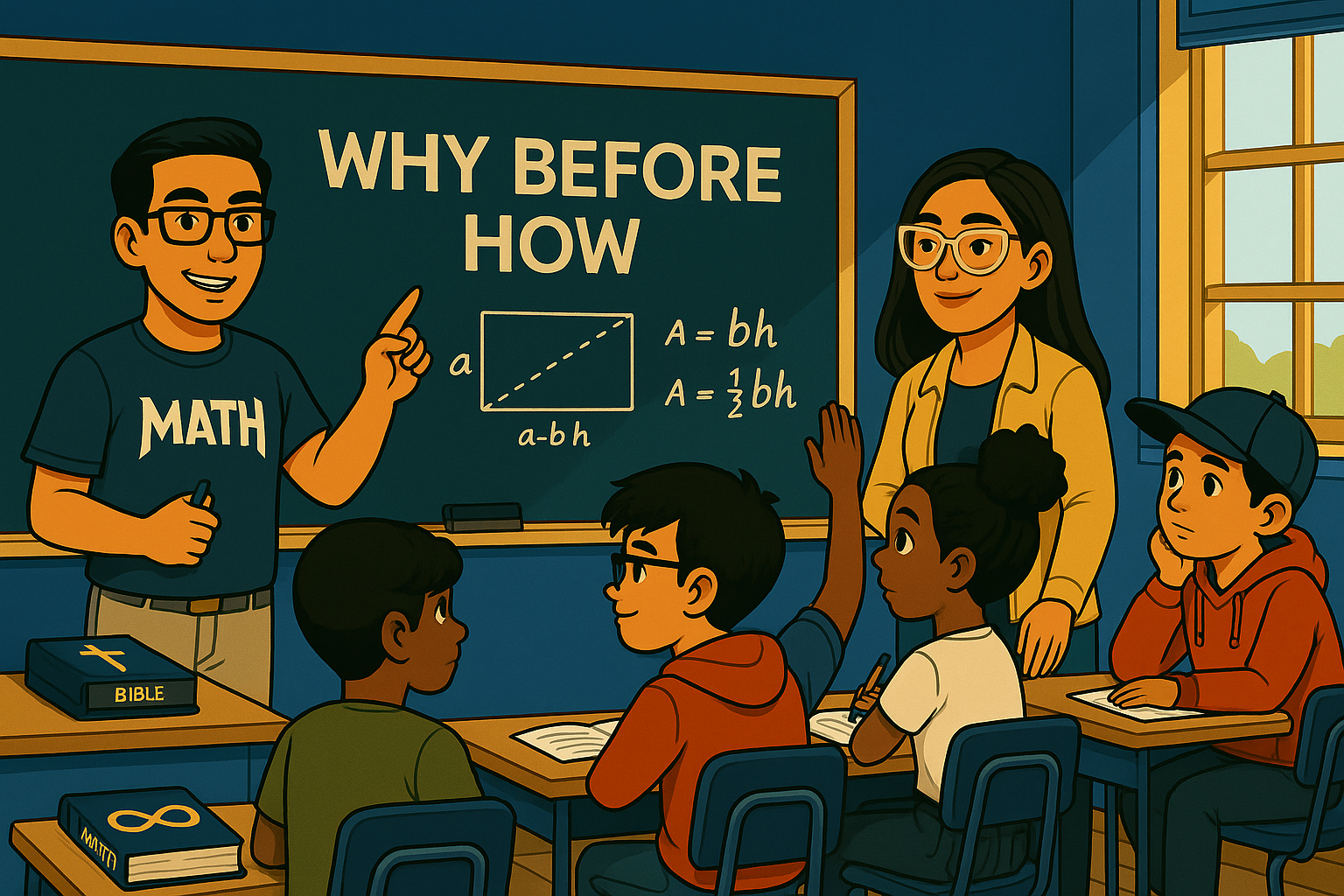
Begin with first principles. Don’t hand a formula—derive it. Ask, “What has to be true here?” (Area of a triangle isn’t a rule to memorize; it’s half a rectangle because of symmetry. That why sticks.)
Name the concept before the computation. Vocabulary isn’t trivia; it’s the handle on the idea. Adjacent vs. consecutive, postulate vs. theorem—precision creates comprehension.
Model the reasoning, not just the result. We show the path, the decision points, and the checks. Kids learn to think like mathematicians, not just do math.
Use error as information. We normalize mistakes as data, not as shame. (“What does this wrong answer tell us about our assumption?”) Courage grows where curiosity is safe.
Interleave and connect. Today’s lesson points back and forward, so knowledge becomes a web, not a stack of index cards.
When students learn the why and how, they carry the truth with them. And truth is what they’ll need when life hurts.
To Teachers Who Feel Handcuffed by the System
You became a teacher to light fires, not to push packets. I get it—mandates, pacing guides, test windows. Here’s how we lead anyway:
Hold the bar steady. Hard days aren’t the time to go soft; they’re the time to be clear. Structure is mercy.
Teach the concept inside the constraint. If you must “cover” slope, spend 5 minutes deriving why slope is constant on a line (rate of change), then practice. You honored the standard and taught the truth.
Narrate your process. “Here’s how I’m staying calm. Here’s how I’m checking my thinking.” You’re modeling a way to be human under pressure.
Protect curiosity. Make room for “why” questions—even one or two per period. Curiosity is the oxygen of learning.
Let faith steady you. You don’t have to preach. You can simply say, “When I’m overwhelmed, I pray for wisdom and peace.” Students don’t need a sermon; they need a steady adult.
Faith, Truth, and the Classroom
You’ll hear, “Don’t bring God into school.” My answer: God is already in the room—present in courage, in love, in truth. You can be honest about where your strength comes from without imposing it on anyone. Share how you seek peace; invite students to seek theirs—through prayer, Scripture, reflection, or quiet. Hope is not a policy; it’s a practice.
A Practical Mini-Playbook for This Week
Open with presence (2 minutes). “Today we’re going to focus our minds. That’s one way we honor people we’ve lost—by becoming better.”
Re-establish structure. Quick agenda on the board. Predictability reduces anxiety.
Teach one big why. Choose the core idea and derive it briefly before practice.
Think-aloud once. Solve one problem narrating your decisions.
Invite one why-question. “What’s one thing about today’s idea you’re still curious about?”
Close with purpose. “Learning is how we move forward—together.”
What I Want Kids to Learn From Us Right Now
That quitting is not an option. That truth is worth the work. That faith can anchor you when feelings are a storm. And that mathematics—the language of logic—trains your mind to see clearly so your heart can act courageously.
When the world breaks your heart, teach anyway. Not because it’s easy, but because it’s right. Our students will remember how we stood far longer than what we covered.