
The Essentials Every Student Must Master Before Middle School
Walk into any middle school math class, and you’ll see the same scene play out: a student freezes when asked to multiply fractions because they never memorized their times tables. Another struggles with geometry because they don’t know there are 12 inches in a foot or 3 feet in a yard. The frustration is real—for students and teachers alike.
It’s not because kids aren’t smart. It’s because they were allowed to move on without the essentials. And when the foundation is missing, everything built on top of it crumbles.
What Matters Most
Expanded form of a seven-digit number? Nice, but not essential. Arrays? Helpful for beginners, but not a hill to die on. Significant digits? Not at the core.
What is essential:
Multiplication tables 1–12, memorized cold.
Mastery of all four operations (addition, subtraction, multiplication, division).
Area = length × width, internalized.
Conversions: 12 inches in a foot, 3 feet in a yard, 5280 feet in a mile.
Without these, pre-algebra becomes a nightmare. With them, middle school math can take off.
Why This Matters for Teachers
Jean Piaget showed us that children move through developmental stages where concrete facts build the scaffolding for abstract reasoning. Erik Erikson emphasized that mastery builds confidence and identity. John Dewey, however, leaned too heavily toward exploration before mastery—an approach that still echoes in classrooms today. Exploration has its place, but not before the basics are secured.
Every teacher in grades 3, 4, and 5 should be reinforcing the essentials and not letting children continue until these skills are mastered. That gives a child three chances to accomplish these necessary tools. A child will only be unprepared if, and only if, all three of these teachers fail to gift the student these powers. Please don’t pass them along without multiplication tables locked in, unit conversions memorized, and the basics of area understood.
How Parents Can Help
Parents have just as big a role in cementing the basics. It doesn’t require a curriculum—it requires consistency.
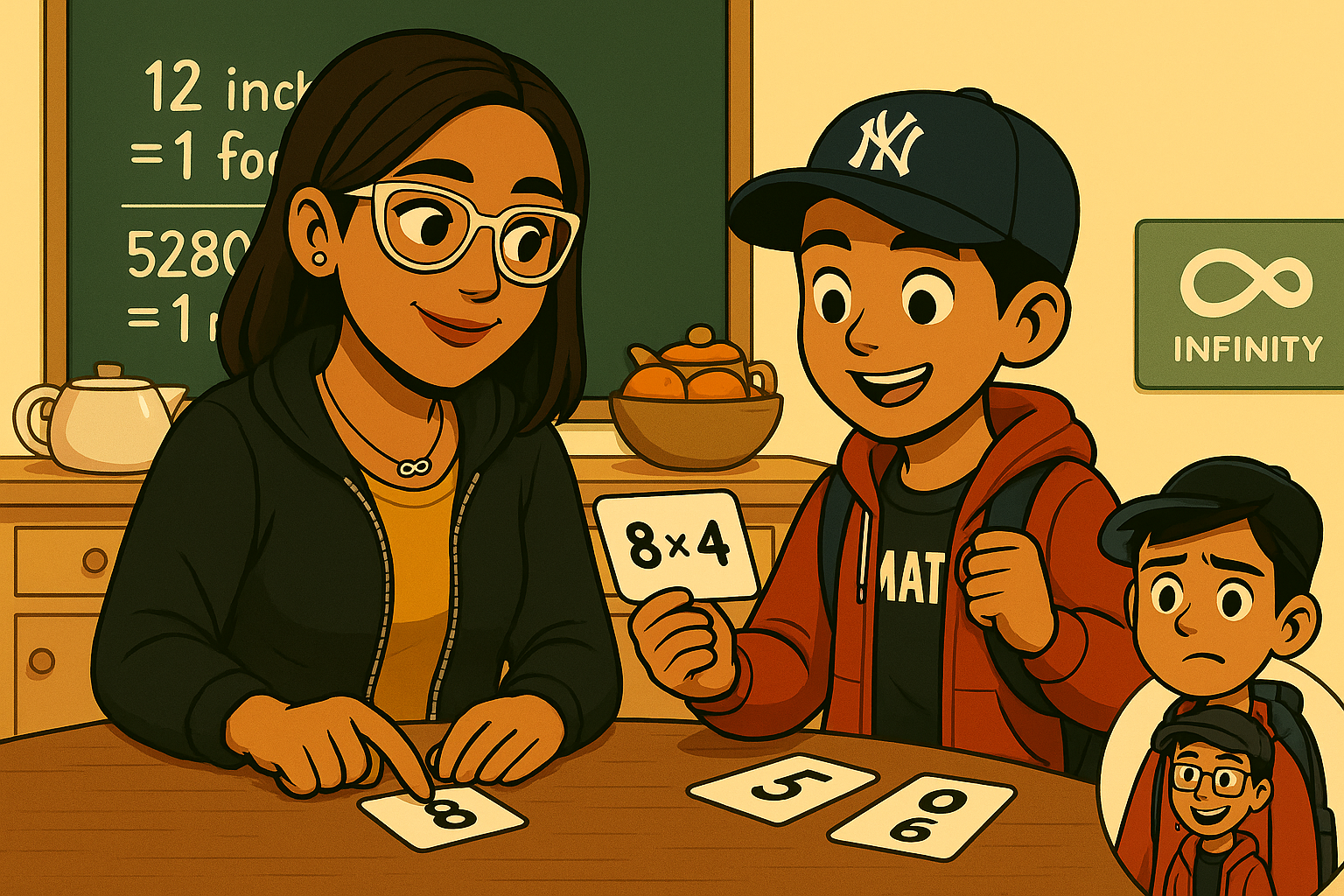
Flashcards at the dinner table: Multiplication, division, unit conversions, even fraction equivalents.
Car conversations: Ask “How far is half a mile?” or “If gas costs $3.60 a gallon, how much is 5 gallons?” These real-life questions connect math to the world around them.
Shopping trips: Hand kids the receipt and ask, “What change should I get back?” or “If these apples cost $2.50 each, how much for four?”
Daily drills: Five minutes of practice each evening beats cramming once a week. Consistency builds mastery.
Parents don’t need to be math experts—they just need to ask questions and hold kids accountable for the basics. These small habits reinforce what’s taught in school and make sure gaps don’t grow into roadblocks.
The Bottom Line
We don’t need flashy methods or endless testing to raise math proficiency. We need foundations, repeated until they stick. Multiplication, division, area, conversions—these are the tools students must carry into middle school.
If teachers hold the line and parents back them up, every child has three years to get it right. And when they do, pre-algebra and beyond stop being intimidating walls—and start becoming open doors.